|
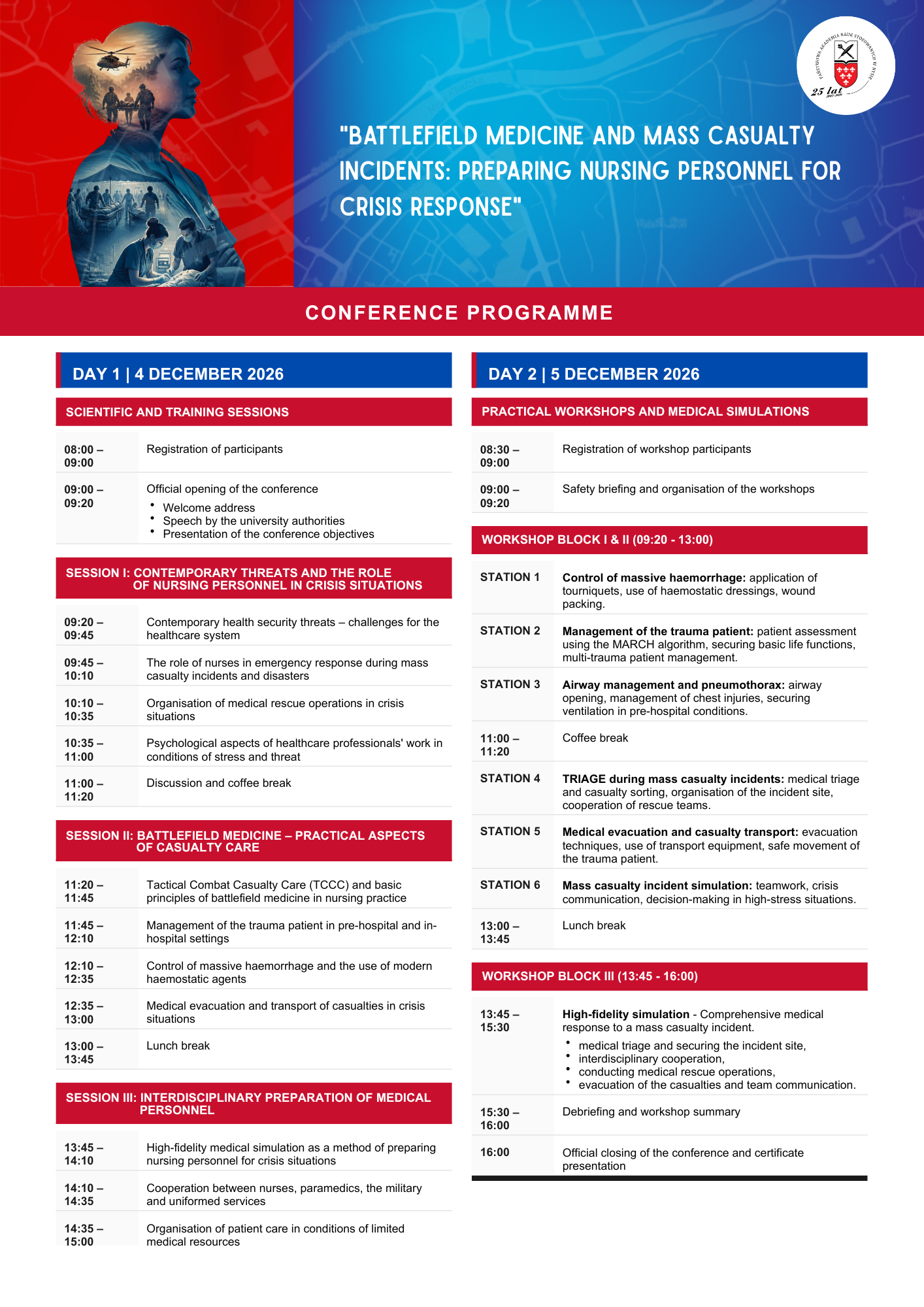
08:00–09:00 |
Registration of participants |
|
09:00–09:20 |
Official opening of the conference • Welcome address • Speech by the university authorities • Presentation of the conference objectives |
Persons on the committee
Partners
Sessions


Venue: University of Applied Sciences in Nysa, Poland
Collegium Polytechnicum; Obrońców Tobruku 5, Nysa
Organiser
University of Applied Sciences in Nysa
Faculty of Medical Sciences – Nursing Programme
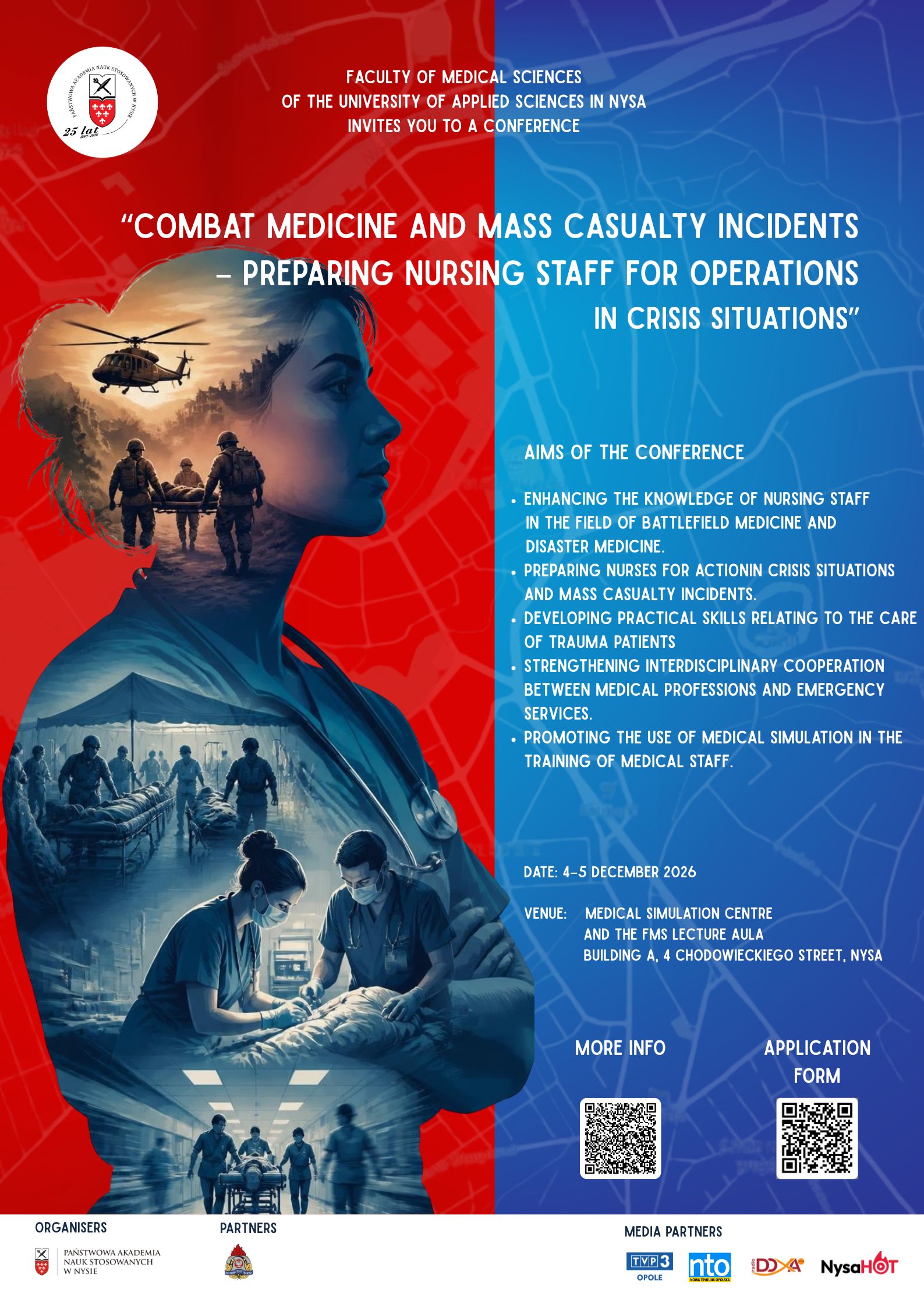
Conference Objectives
The conference aims to:
Who Should Attend?
The conference is open to nurses, paramedics, nursing and emergency medical services students, healthcare professionals,
academics, emergency responders, and anyone interested in battlefield medicine, disaster medicine, and crisis response.
SCIENTIFIC COMITTEE
prof. dr hab. n. med. Małgorzata Muc-Wierzgoń
prof. dr hab. n. o zdr. Beata Jankowska-Polańska
prof. dr hab. n. med. Krystyn Sosada
dr n. med. Ireneusz Barziej, prof. ucz.
dr n. med. Dariusz Sokołowski
mgr Lucyna Frihauf
ORGANISING COMITTEE
dr n. med. Ireneusz Barziej, prof. ucz.
mgr Lucyna Frihauf
mgr Katarzyna Kulińska
mgr Agnieszka Grabowska
mgr Łukasz Styś
mgr Małgorzata Gądek
mgr Barbara Próchnicka
mgr Patrycja Prościak
mgr Paweł Merkel
mgr Anna Opałka
Costs& registration
Participation is free of charge. Prior registration is required.
The event combines scientific knowledge, professional experience and hands-on training, with a particular emphasis on practical skills and interdisciplinary cooperation. The conference offers an opportunity to enhance professional competencies, exchange knowledge and experience, develop practical crisis-response skills and establish cooperation between healthcare institutions, universities and emergency services.
Scientific Sessions and Expert Discussions
Lectures and discussions will address health security, emergency response organisation, Tactical Combat Casualty Care (TCCC), trauma management, medical evacuation, psychological aspects of crisis response, healthcare cybersecurity and cooperation between medical personnel, emergency services and the military.
Practical Workshops and Medical Simulations
Hands-on training will focus on massive haemorrhage control, tourniquet application, wound packing, trauma assessment, airway management, medical TRIAGE, casualty evacuation and teamwork during simulated mass casualty incidents. The programme will conclude with a high-fidelity medical simulation, debriefing and certificate presentation.
|
08:00–09:00 |
Registration of participants |
|
09:00–09:20 |
Official opening of the conference • Welcome address • Speech by the university authorities • Presentation of the conference objectives |
|
09:20–09:45 |
Contemporary health security threats – challenges for the healthcare system |
|
09:45–10:10 |
The role of nurses in emergency response during mass casualty incidents and disasters |
|
10:10–10:35 |
Organisation of medical rescue operations in crisis situations |
|
10:35–11:00 |
Psychological aspects of healthcare professionals' work in conditions of stress and threat |
|
11:00–11:20 |
Discussion and coffee break |
|
11:20–11:45 |
Tactical Combat Casualty Care (TCCC) and basic principles of battlefield medicine in nursing practice |
|
11:45–12:10 |
Management of the trauma patient in pre-hospital and in-hospital settings |
|
12:10–12:35 |
Control of massive haemorrhage and the use of modern haemostatic agents |
|
12:35–13:00 |
Medical evacuation and transport of casualties in crisis situations |
|
13:00–13:45 |
Lunch break |
|
13:45–14:10 |
High-fidelity medical simulation as a method of preparing nursing personnel for crisis situations |
|
14:10–14:35 |
Cooperation between nurses, paramedics, the military and uniformed services |
|
14:35–15:00 |
Organisation of patient care in conditions of limited medical resources |
|
08:30–09:00 |
Registration of workshop participants |
|
09:00–09:20 |
Safety briefing and organisation of the workshops |
|
STATION 1 |
Control of massive haemorrhage: application of tourniquets, use of haemostatic dressings, wound packing. |
|
STATION 2 |
Management of the trauma patient: patient assessment using the MARCH algorithm, securing basic life functions, multi-trauma patient management. |
|
STATION 3 |
Airway management and pneumothorax: airway opening, management of chest injuries, securing ventilation in pre-hospital conditions. |
|
11:00–11:20 |
Coffee break |
|
STATION 4 |
TRIAGE during mass casualty incidents: medical triage and casualty sorting, organisation of the incident site, cooperation of rescue teams. |
|
STATION 5 |
Medical evacuation and casualty transport: evacuation techniques, use of transport equipment, safe movement of the trauma patient. |
|
STATION 6 |
Mass casualty incident simulation: teamwork, crisis communication, decision-making in high-stress situations. |
|
13:00–13:45 |
Lunch break |
|
13:45–15:30 |
High-fidelity simulation – Comprehensive medical response to a mass casualty incident. • medical triage and securing the incident site, • interdisciplinary cooperation, • conducting medical rescue operations, • evacuation of the casualties and team communication. |
|
15:30–16:00 |
Debriefing and workshop summary |
|
16:00 |
Official closing of the conference and certificate presentation |
Honorary Patronage
Honorary Committee
Scientific Patronage
Expert Patronage
Media Patronage
Conference Partners
E-mail: piel.takt@pans.nysa.pl
ireneusz.barziej@pans.nysa.pl
Telefon: 604680579